INTERNATIONAL WEBINAR ON CHILD RIGHTS

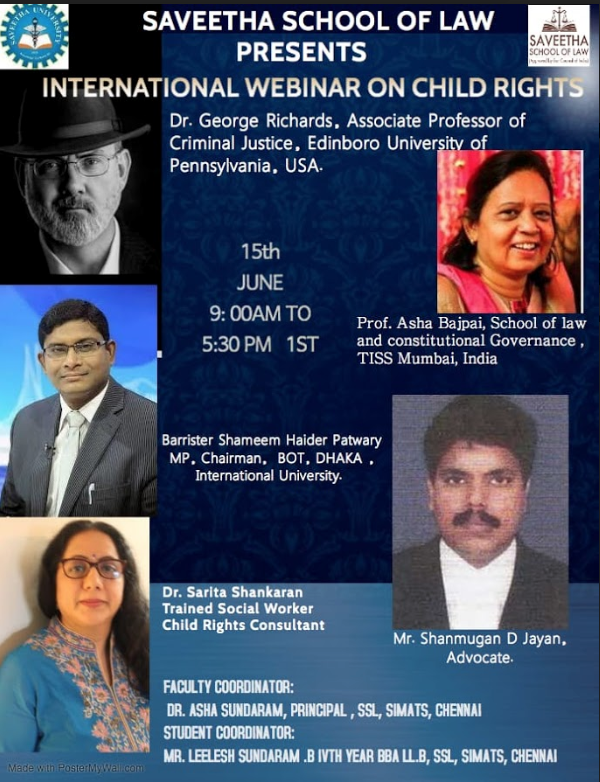
Saveetha School of Law organized International Webinar on Child Rights on 15th of June, 2020. It commenced at 8 am and successfully concluded at 8 pm. This webinar is the third edition of the International Conference on Child rights organized by the institution every year. The faculty coordinator for the event was Prof. Dr. Asha Sundaram, Principal, Saveetha School of Law and the student coordinator was Leelesh Sundaram. B, 4th year (BA. LLB).

The webinar commenced with a session by Mr. Shanmugam, Advocate. The session was held from 8:00 am and 9:00 am. The speaker discussed different aspects of child rights with respect to the Information Technology Act. Mr. Shanmugam gave a clear over view of the affirmative actions taken by the legislature under the IT Act to curb offences against children. The speaker also elaborated on the proceedings in a court relating to offences against children. Mr. Shanmugam also discussed the precautionary steps that parents need to take for protecting children and reducing the levels of victimization.

Presentation of research papers by students commenced at 9 am. Ashish Jaangda was the first student to present his study on the effects of violent video games on children and adolescents followed by Akshaya GV on the topic ‘Neglected Street Children and Measures to Improve their Livelihood.’ The presenter quoted many case laws and the directions made by the Court in uplifting such children. She answered to the queries posed to her by the audience. Chewtha was the thirs presenter and her topic was ‘Legal frameworks for Children in Conflict with Law in India.’ She focused on the lacunae or ambiguities of many legislations by comparing some legislations with those followed in other countries. The next presenter was Deepika and hers was a study on child begging in India. She linked her topic to Article 24 of the Constitution and pointed out the flaws of Government in bringing an effective legislation. The last presenter of the session was Eorlina Pearl on the topic ‘Analysis on the Health Issues faced by Girls due to Child Marriage.’ She focused on the practice of child marriage which was still prevalent in some parts of the country. She also discussed problems that arise from child pregnancy. The session was moderated by Mr. Ahmed Razouki.

This was followed by a presentation by Gayathri U on prevention of physical abuse of children in India. She discussed about the consequences and its relevance. Following that Harshit S Jain explained about child trafficking and laws prevailing in India. He suggested that corruption is the key reason for nullifying the efforts taken to end trafficking. Next presenter was Hasika who presented her study on protection of children from sexual abuse. She pointed out the weakness of the legislation and social tuning that impacts sexual abuses in India. This was followed by Indhumathi who presented her study on national crèche scheme in India and its role in child development. The last presenter was Indrapriya who presented her topic on child labour regulations and constitutional rights in India. She focused on the inefficiency of the existing system. This session was moderated by Mrs. Gayathri P and Mrs. Arya R.

The next set of presentations commenced soon after, wherein Keerthan M Murali presented his study, ‘An Analysis on role played by the Indian Legislature in the Curb Juvenile Substance Abuse in Urban India.’ He began the presentation by introducing the topic and explaining the concepts of drug and drug abuse followed by a short introduction of substance abuse by teens. He concluded by providing suggestions on how the legislation can improve efficiency in curbing the problem of juvenile drug abuse. This was followed by a presentation on ‘Legal Perspective of Juvenile Delinquency with respect to India, the USA and Europe’ by Inian.I. The presenter started the session by providing an introduction to the topic and whether the present laws in our country are stringent enough to curb out or reduce the rate of crimes committed by the juveniles. The legal frameworks followed in other countries were discussed as well. The next presenter was Kavitha. D who presented her study on ‘CHILD PORNOGRAPHY.’ She focussed on Online child PORNOGRAPHY Consumption Spikes in India during the lockdown which had made the internet an unsafe place for. Keerthana. S presented her study on ‘The Role of Juvenile Justice Act in Controlling Crimes’. The scheme of the Act was well explained with provisions and definitions. The international laws of France, UK, USA, Italy, Canada and Germany were discussed with the age group of child offenders and laws relating to them. This was followed by the presentation by S.P.LATHIKA SRI on the topic ‘Importance of promoting cyber Security awareness among Children.’ The presenter started the session by highlighting the importance of promoting cyber security awareness among children. The session also dealt with the existing awareness campaign in India and the threat faced by the internet users. This session was moderated by Ms. Jayapreethi.

Dr. Betsy Rajasingh moderated the session on child rights with specific emphasis to the Indian scenario. The session consisted of four final year student presenters from Saveetha School of Law. Dr. Rajasingh, welcomed the student presenters and participants, and commenced the session with a short introduction about child rights. The first speaker Mr Vignesh was then invited to speak on the topic, “A Study on Effective Implementation of Right to Education in Government and Private Schools.” He commenced his discussion talking about the constitutional mandate regarding elementary education in India and went on to give a comparative analysis of the differences between public and private schools. His presentation was followed by Ms Mahima Makhija’s talk on “A Study on the Protection of Children from the Impact of Neglect and Abuse”, where she focused on the impact of parental neglect and the consequent abuse faced by children at a relatively young age. Subsequently, Mr Monesh Boopalan, while dealing with his topic “ Child rights in India” dealt at length with the legal safeguards available in India and the effectiveness of implementing mechanisms with reference to child rights. He also discussed the international obligations relating to child rights and the consequent domestic provisions implementing the same. The final speaker of the session, Ms. Namitha, spoke on the topic “A Study on the Effects of Early Exposure to Internet on Children”. In particular, she emphasized the effects of the internet boom and the consequent ill-effects on children due to early exposure to the internet. The moderator engaged the panellists and a lively discussion ensued throughout the session, where the presenters were able to answer questions raised by the Moderator and the participants. In short, it was an engaging and enlightening session for all.

The next set of presentations were delivered by student Padmasri on ‘A Study on Use of Children as Soldiers in India’, followed by PARIDHISELVAN who presented ‘A Study on the Impact of Poverty on Children with Relation to Crime in India.’ This was followed by presentation by PREETHI on ‘A STUDY ON RIGHT OF CHILDREN AGAINST TRAFFICKING FOR SEXUAL EXPLOITATION IN INDIA.’ This was followed by R KALAIVANI who presented her topic ‘A STUDY ON RIGHTS OF CHILDREN WITH SPECIAL NEEDS IN INDIA.’ The session was interesting and queries were posed by the audience. The session was moderated by Ms. Aysha Fida.

Another round of presentations were moderated by Ms. Sornalakshmi in which students presented the topics related to impact of judicial separation on children, the doctrine of parents patriarch and protection of children post adoption, child abuse and neglect, education provided to children with dyslexia and legality of home schooling. The presenters mainly focussed on the current scenarios relevant to the above mentioned topics. The most sensitive phase of this webinar happened to be the lack of care and protection and abuses faced by the children that paved the way for these children turning into neglected juveniles. Students also delivered their findings and suggestions related to appropriate legislations that strengthened their research. The highlight of this webinar was that of education provided to children with dyslexia and legalization of home schooling and it's impacts.

The second session of the conference was held between 12 noon and 1:00 pm. The speaker of session was Dr. Sarita Sankaran, trained social worker and child rights specialist. She spoke about psycholologial aspects of child rights wherein she advocated the need for shift from a rights-based approach to a need-based approach. Dr. Sarita discussed the mental and emotional barriers in children who are victims of abuse and exploitation. She provided an over-view on the need for affirmative action from psychological point of view.

The third session was held between 2:00 pm and 3:00 pm. The session was led by Dr. Asha Bajpai, Professor and Dean (Rtd), School for Law, Tata Institute of Social Sciences. The speaker of the session explained about the rights of mentally ill children and shared her experience of working with these children. Dr. Asha Bajpai appeared as an amicus curie in a su moto case of the high court of Mumbai concerning children. She shared her views for protection of such children and reintegrating them into the society. The speaker also shared her views on the trauma and abuse which the children of sex workers are subject to.

The closing session was delivered by Dr. George Richards, Associate professor, Endinboro University, University of Pennsylvania between 4:30 pm and 5:30 pm. The speaker spoke on victimization of children and child refugees. He highlighted that community violence often excludes the different forms of child maltreatment that includes neglect and emotional abuse wherein children suffer at the hands of caretakers. The speaker also enumerated that the distinctive forms of child victimization are routinely neglected in research. Dr. George Richards threw light on the effects of war on children and the forms of abuse that child refugees are subject to.

The afternoon session included presentations by students on their respective research topics.

Shanmathi R presented her paper on the title Protecting Future Rights of Future Citizens: An analysis on the problem of Child Labour and gave a brief insight on the loopholes in the present labour legislations and suggested measures to completely curb the practice of Child Labour in India by amending statues with a reformative approach. Shruthi Taarana presented her paper on the title ‘A Study on Child Adoption in India’ through which she explained in detail about the need for uniformity in adoption laws to all religions. Shanthini P made a wonderful presentation on her research titled ‘Psychological Problems faced by school children’ through which she suggested measures for proper implementation of statutes which will eventually lead to the betterment of the present situation. Sri Durgapriya K G presented a her paper on the title ‘A study on prevalence of Bonded Labour amongst Children and its Abolition’ where she emphasised the need for the leaders of a society to work together in order to stop child exploitations. Soniya P presented her paper ‘A study on Children at work – a form of modern slavery in India’ where she discussed the necessity of fund allocation to educate and nurture poor children. Lastly Sajithra M dealt with her research on the topic, ‘A study on Analysis of implementing Juvenile Justice Act’ in which she criticized that reducing the age from 18 to 16 will not hold good for society. The session was quite interactive as students came up with innovative ways to tackle the current system of oppression, suppression and depression among the children of the society. The session was moderated by Dr. Asha Sundaram and Ms. Aswathy Prakash G.

The last session of paper presentations included 80 participants. Dr. Asha Sundaram, Principal, Saveetha School of Law, started the session with an inaugural speech on child rights in India. This was followed by student presentations, covering kidnapping and abduction, , causes and Prevention of juvenile delinquency, violent music on children affecting the children’s behaviour towards others, child sexual abuse and Aasifa’s case were discussed in detail. All the presentations were followed by questions put forth by participants, which made the whole session interactive, interesting and thought provoking. The session was moderated by Ms. Priyadharshini.

Read More
COVID: IMPACT ON LEGAL SECTOR AND ITS RECENT DEVELOPMENTS.

The resource person Ms. Aditi Mishra delivered her seminar by interacting with the participants by asking whether the COVID has positive or negative impact on the legal system. Simultaneously, she substantiated the points for birth sides by saying it has positive as well as negative impact. Explained about the benefits and drawbacks of e-courts and case hearings. Procedure for online court hearings. She then dealt with the developments and changes brought by the court (I.e.) legal system to the general public. Mentioned about the judgments given by Supreme court and high courts to protect and save the normal public livelihood.

Read More
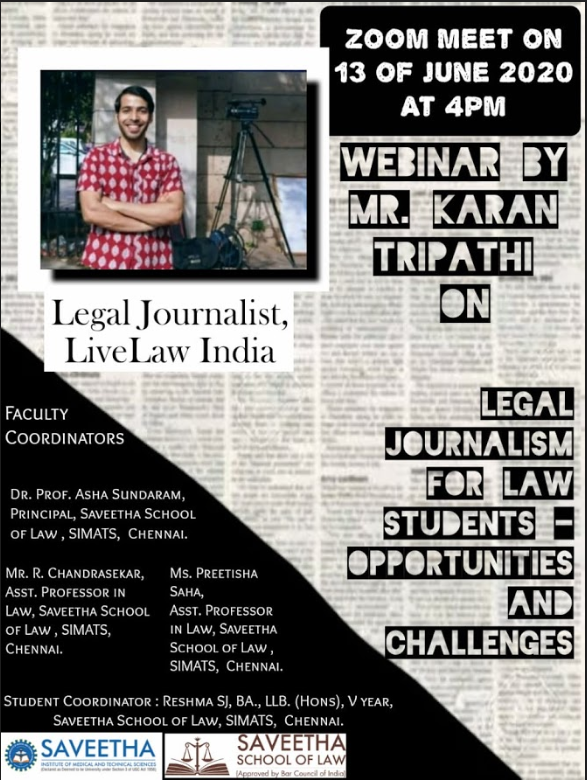
LEGAL JOURNALISM FOR LAW STUDENTS: OPPORTUNITIES AND CHALLENGES

The topic of the webinar was about how legal journalism works and opportunities for law students in the field.

The guest speaker in the first part of the webinar gave a brief introduction about legal journalism and his work experience which included his journalistic research of various cases - Corruption and money laundering case of P. Chidambaram, execution proceedings of the Nirbhaya Case, Anti- Citizenship Amendment Act Protests, Delhi Riots, Jamia Islamia Violence. It was also summed up that Legal Journalism requires training in journalistic writing and research with a side of knowledge of law.

The second part was very interactive where to the participants' question, it was answered that passion is the key to pursuing legal journalism and that keeping an eye out for Internships is the key for law students in the field.

Read More
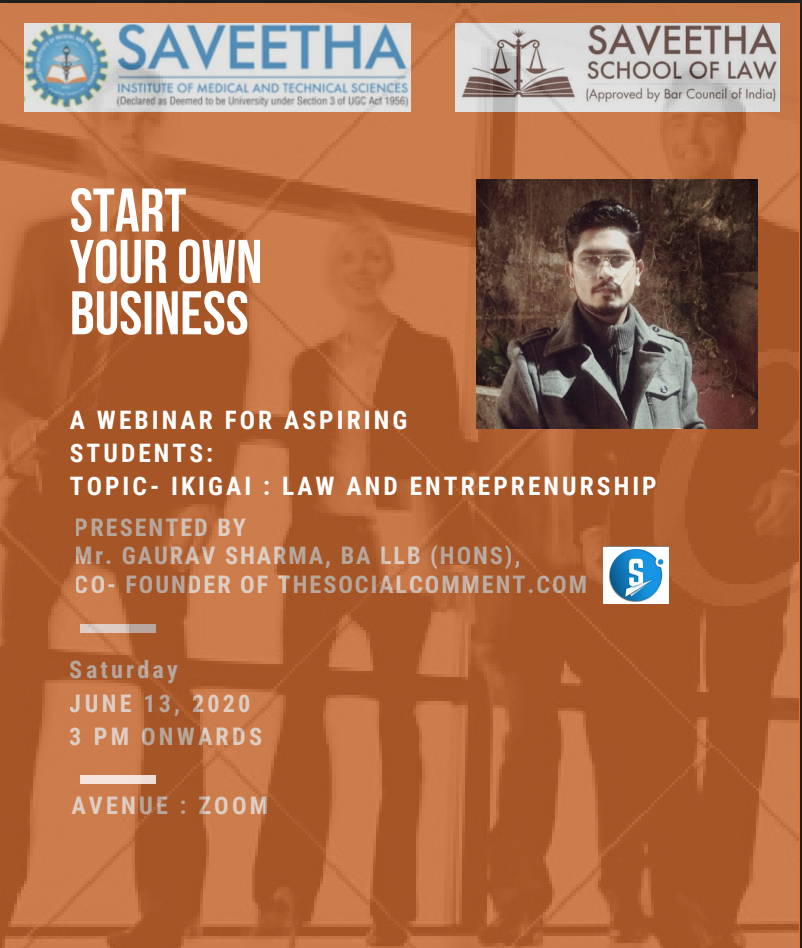
Ikigai : Law and Entrepreneurship

Mr. Gaurav Sharma, was the resource person of this webinar. He provided a pie chart to explain the session for the participant to understand easily. He explored entrepreneurship activities, goals, vision , mission, motive, etc through his chart. Also he pointed out what things should be before starting a carrier and which flows down in how to develop the skills for creating a platform in their business. He explained his experience in the virtual platform and most importantly he told about what all the activities an entrepreneur will follow. At last multiple questions are asked by the participant and he provides a solution just in three words: be unique, be positive and be responsible.

Read More
Politics In Architecture And Urbanity - Construction As Activism

The resource person Mr. Aswin Senthil (Architect) in his brief session introduced the concept of Politics In Architecture And Urbanity - Construction As Activism . He spoke on how Liberalisation, Privatisation & Globalisation played an important role in the national infrastructural development. He explained how and why most governmental infrastructure programs have failed to achieve the promised targets. He also spoke of the need for transgendered spaces. The resource person was patient enough to solve the doubts raised and encouraged inquisition. The organiser conclusively gave a closing note thanking the resource person for donating his time and the management & Principal for providing with this opportunity. It was an enlightening session on a much needed area of law.

Read More
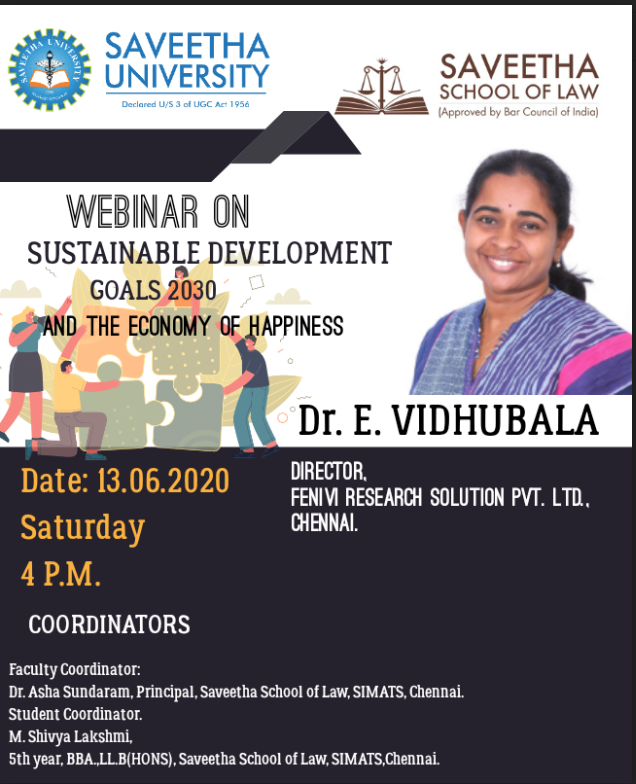
SUSTAINABLE DEVELOPMENT: GOALS 2030 THE ECONOMY OF HAPPINESS

The webinar was specifically about sustainable development and the economy. Dr. E. Vidhubala started with the Present scenario of the Indian Economy and the distribution of Wealth. She explained how the rich accumulate wealth and the poor is only poorer than before. She elaborated on the GDP and the per capita income of India and the significance. She gave a specific analogy to show the higher per capita income does not mean a happy and healthy economy.

Dr. Vidhubala being an expert in the rural economy and its policies gave her insights on the current Covid-19 scenario as well. She explained the NITI AYOG, the think tank of Indian Govt, their fund allocation, and the insatiable willingness to attain sustainable development in the Economy before the year of 2030. She also explained many achievable goals the NITI AYOG has planned to adopt.

Read More
EVOLUTION OF LAW AND SPACE EXPLORATION

The webinar was conducted by Mr. M.S. Parthiban, Advocate at Madurai Bench of Madras High Court. He has done his Bachelors in Aeronautical Engineering from Anna University and Masters in Space Engineering Rocket Science from Birla Institute of Technology. Then pursued a Law degree.

The session began by the Speaker explaining the basics of space and outer space. Gradually dwelled into the topic, and enumerated about the five major treaties that are existing regarding the space, namely the Outer space Treaty, Rescue Agreement, Space liability, Moon Treaty. He mentioned all the important Articles in the Outer Space treaty, 1967. He concluded the session in 1 hour 20 minutes, and answered the questions raised by the participants towards the end of the meeting.

Read More
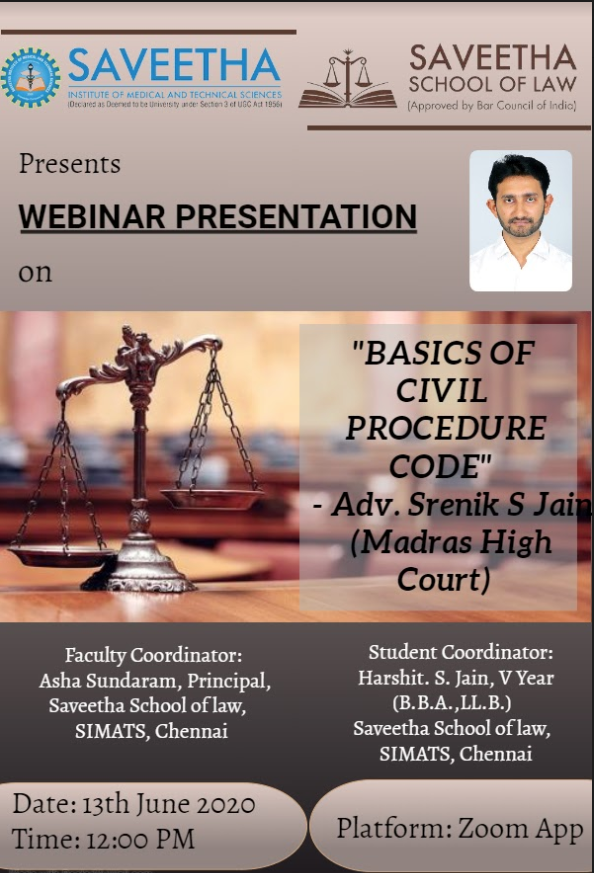
BASICS OF CIVIL PROCEDURE

“Mr. Srenik S Jain”, who is a PAN India Advocate. In the span of 8 years of his practice, he has also appeared before the Supreme Court of India. He has been practicing in the field of civil, corporate and real estate cases. Till date, he has been successful in handling various corporate giants like PVR, and Satyam Cinemas. He has also contributed his professionalism towards the establishment of VR Mall, Chennai.

Mr. Srenik initially gave an introduction about Civil Procedure Code and then explained the basics of CPC in parts. He explained how to institute a suit and how jurisdiction is to be determined. Adv. Srenik S Jain, also explained what is a plaint and what are the important segments of a plaint. He also explained to the participants as to how the suit is numbered once it is filed, followed by the concept of issuing summons and filing of a written statement by the defendant. He also explained as to how the issues are framed once the pleadings are filed. Further, he also focussed on the primary and secondary evidence and how they are marked in the chief examination. Thereafter, he explained about the cross examination and re-examination of witnesses in the trial process. Finally he also explained about the final hearing followed by judgement and decree and the difference between the two. Mr. Srenik also provided a sample of plaint, judgement and a decree for a better understanding of the topic. Lastly he also answered a few questions that were raised by the participants and then the session was concluded.

Read More
Role of lawyers on banking/financial Institutions

Mr.Boopalan has spoken about the Role of a lawyer in Banking/Financial Institutions. He has portrayed that lawyers have three different roles in financial institutions . Corporate legal, Title Documents - Legal opinion, Litigation Management are the three different roles in which a lawyer can play in banking or financial institutions. The other roles are Verification of legal documents, Legal Opinion on title documents and Execution of valid documents to protect the interest of the bank.I conclude by saying that, to step up into the financial institutions or the banking sector it's quite important to have knowledge about the procedures in the area of filing applications, drafting, inspecting documents and abit of SARFAESI Act.

Read More
Surrogacy-Commercial and Legal Issues

The speaker started her session on the overview of Surrogacy. The speaker covered all the basic aspects of Surrogacy types and kinds.Surrogacy in India is The world's second and India's first IVF (in vitro fertilization) baby, Kanupriya alias Durga was born in Kolkata on October 3, 1978. And in India it has been done in low cost. The lecture moved on to the Problems of Surrogate Mothers. These women have no right to make decisions regarding their own body and life. The worst part is that in case of unfavorable outcome of pregnancy, they are unlikely to be paid, and there is no provision of insurance or post-pregnancy medical and psychiatric support for them. The lecture explains some of the case laws related to Surrogacy (i) Baby Manji Yamada vs Union Of India, 2008 (ii) Baby Dev Case, 2012 (iii)Rama Pandey vs Union Of India, 2015. Legislations Related to Surrogacy

Read More
Biodiversity

Mr.M.R.Vinoth Prabhu was the resource person dealing about the topic biodiversity .

M.R.Vinoth Prabhu dealt with few articles with related to constitutional law they are

Article 253

Article 48A

Article 51A

Then he thought about the Various IPR Copyright act,1957 .

The national biodiversity and individuals will enter into an agreement in the non judicial stamp paper and from one state to another state they cannot get the stamp paper and they have to get the stamp paper in that particular state

Read More
SUPREMACY OF THE SUPREME COURT

Indian constitution is broadly classified into the Legislature, the Executive and the Judiciary. The Legislature is meant to make laws and the Executive is bound to enforce those enacted laws for the welfare and upliftment of the people at large. The main function of the Judiciary is to check upon the Legislatures and the Executives from violating any of the provisions of the Constitution, more particularly the fundamental rights guaranteed under Part III. That is the reason, the Supreme Court is considered as the custodian of the constitution. There are certain constitutional provisions which make the supreme Court of India as unique and the highest court of the land. What are those provisions which are considered to be “Supremacy of the Supreme Court”?

Read More
PANDAMIC LAW

The speaker of the session was Mr. Rebin Vincent Gralan (Advocate of Bombay High court). The beginning of the session dealt with how the pandemic started from 19th century. The Epidemic Act, 1897 and plague disease was introduced at the first part of the webinar. The powers given to the Zila parshids and hospital in the epidemic Act was discussed and it was very informative. As the webinar discussed about the current topic the quarantine rules were explained clearly to the participants. An overview of IPC sections relating to the public health, National Disaster Act, 2005 and provisions dealing with pandemic situations was explained. The speaker dealt with the protection of vulnerable people at the times of widespread diseases. All the provisions relating to the pandemic law was clearly explained.The session was very much useful to all the participants who participated. The outline of MHRD guidelines were given. The New ordinance on Pandemic Act, 2020 was introduced in the session. As a Whole, it was very informative and insightful session…!

Read More
GEOGRAPHICAL INDICATIONS IN INDIA

The session started with an exclusive PPT about Bill of lading and further extended the topic of BOL, it’s history , importance and the details, condition and capacity along with the purpose of the document. And how it will be changed after Covid 19 and it’s Practical aspects during the digital Era. An original Bill of lading showed along with a clear explanation. Further the question of participants has been cleared like How it helps in letter of credit, process of letter of credit in India. And the session ended with a Vote of thanks to Resource person and participants by the host of the session.

Read More
Law relating to Women in India.

Ms. Vishalini. S gave insightful sessions by providing the importance of Women rights in India. She started with a brief historical background of how the women were treated in the Ancient, medical and pre independence period. She also highlighted the Devadasi system. Then she explained about the problems faced by women in India and what are the legal provisions and legal remedies available for them. She also enlightened the audience by explaining the independent bodies for women empowerment and various landmark judgments and precedents that help the women to be upper hand and dealt with the recent amendments. She then focused on gender equality and legal provisions for women and various constitutional provisions that are enshrined specifically for subaltern groups i.e. women in India.

Few participants raised interesting questions which kept the session very interesting and interactive. Everyone could gain knowledge about this concept.

Read More
Crime Scene Investigation

Dr.Ramalingam ,the resource person enlighten the session on Crime based investigation. He laid out the emphasis on what to do if a Crime occurs and also taught about the six W’s in the Crime scene investigation and explained in detail about the mediums and in establishing those Crime cases . He taught in detail about what was the link to show up those evidences .and to make it more interesting he taught about the term evidence its importance .He posted out many questions as when to visit the scene of Crime and what you should do once a Crime occurred and he clearly taught all those measure and steps so efficiently.Last he summarised the seven S’s in Crime scene

At the end of the session students posted interesting questions and the resource person answered all the questions put forth by our student in a clear and efficiently.

Read More
Privacy and Data Protection - A Global Perspective

The Speaker for today's session was Ms. Akshaya Suresh who gave a brief introduction into the topic and how Data and Privacy Law gets pushed under Constitutional Law. The Speaker walked us through the various judgements in India in which Right to Privacy was not recognized and how that notion has now changed . She then touched upon the recent Privacy Data Bill which has been sent to the Standing Committee. This Privacy Bill is largely influenced by the GDPR and the EU Data Privacy Law.She signed off by providing an idea about how to pursue a career in the field of Data and Privacy Law in India. The session was interesting and it was kept simple which helped the participants in getting a global picture on Data and Privacy Law.

Read More
ENTREPRENEURSHIP- GROWTH AND COMPETITIVENESS

The resource person Mr.Navin raja started his lecture by sharing his own life experience as an entrepreneur, how he struggled in initial stages. He also covers various fields like profession, passion and entrepreneur. The guest expressed some social issues and explained how to balance a life as an entreprenuer. He gave ideas to become an entrepreneur as well as a Professional. Once he finished his seminar, the participants raised their questions and the guest replied to their question.

Read More
Webinar on Entrepreneurship

Dr.S.R.Sathyanarayanan the resource person of the webinar , laid out the emphasis on the term entrepreneur,entrepreneurship and enterprise, the characteristics of entrepreneurs its impacts with simple illustrations so that it would be more beneficial for the students to understand because the term entrepreneurship was quiet new topic for the students to understand .Then he spoke about the quality of entrepreneurs .on the whole it was very interactive session and students asked many questions and the resources person answered all the questions put forth by the student in very efficient manner .

Read More
Negligence and its legal implications in dentistry

The introduction was given by Subin Abraham. The main purpose of this topic is to educate the lawyers about the type of treatment the Dental practitioners do and about the legal claims. Further the speaker gave a in depth speech about Consent form. Consent in dentistry also becomes the important area where consent of the patient should be obtained before the procedure starts, failing which the concerned practitioner falls liable under Tortious or Criminal liability depending upon the nature of the case.

The speaker finally concluded that mistakes occur in every profession and it is an individual's duty to avoid it.

Read More