PRINCIPLES AND PRACTICES OF DRAFTING

A Webinar was delivered by Mr.S.Siva shanmugam. He is an advocate in the madras high court and he has more than 25yrs of experience in the field of practise.

The Webinar was on Principles and Practises of Drafting. Mr.S.Siva Shanmugam started the session by explaining what is drafting. Then he went on to explain what is the importance and objects of drafting and why it is necessary to draft the plaint and the written statement in a simple language. Then pleadings was explained by him. There are three pleadings - plaint, written statement, affidavit. Plaint is specified in ORDER VII RULE 1. Then written statement was explained by him which is filed by the defendant in reply to the plaint given by the plaintiff. Then he also dealt with what is affidavit. Then he explained what are the contents of an affidavit. He mainly explained counter affidavit and re-joinder affidavit. In an affidavit only the facts must be mentioned and not the inferences. Then speaker clearly specified what is a pleading and what are the contents of pleadings. He also dealt with facta probanda and facta probantia. At the end he summed up the whole topic by explaining the important terms.

The webinar was co-ordinated by Mrs. Asha Sundaram(Principal)(faculty co-ordinator) and Sri Jayashree.G, Vth Year, Reg No: 131502029, BBA.LLB(HONS)(Student Co-ordinator).

The number of participants in the webinar was 30.

Read More
FILING OF REPRESENTATIVE SUIT

A webinar was delivered by Mr. A.R.NIXON. He is a senior advocate practicing in the High Court of Madras and have experience of more than 30 years.

The topic was Filing of Representative Suit. The

speaker started the session by explaining the meaning of representative suit. The reasons for filing the representative file was discussed. Using illustrations the speaker addressed the difference between the normal legal notice and notice served incase pf representative suit. The speaker explained it with the help of some case laws along with the citations. The representative suit should be filed where many people are included as parties to the suit. He spoke about the percentage of court fees. The main core factor throughout the discussion was about filing the representative suit and how a notice should be served. In case of representative suit, the court orders to publish where the publication circulates throughout the state or throughout the world because the party may be residing out of state of out of india. The speaker dealt with the procedure for filing and withdrawing the representative suit and addressed the main reason for the losing a case in representative suit is because of not following the proper procedure.

Read More
A WEBINAR ON DIRECTORS IN COMPANY LAW

The Resource Person Mr.Sathish Kumar, Senior Executive in Tata Consultancy Services was the speaker of the webinar session conducted on 08/06/2020. The session started by 2.00 Pm onwards.

The topic was about Directors in Company Law. The Speaker started the session by stating the meaning of directors and company. And briefed the topic by presenting PPT which was shared to the audience. The Speaker further explained about the types of directors, Difference between Executive and non executive Directors, Managing Directors, Independent Directors. The speaker also stated about the Conditioning for Appointment Of Directors, duties of directors, Removal Of Directors by Shareholders under Section 284 Of Companies Act 1956 and Removal Of Directors by Central Government dealt under Section 388 B to 388E Of Companies Act 1956, As per Sec. 402 Removal of Directors by National Company Law Tribunal, Meeting and reasons for calling a board meeting. The Speaker Concluded the session stating the importance of Directors in Company Law.

Read More
ENVIRONMENTAL LAW AND POLICIES

With a Number of 15 Student participant Miss MJF LN Sri Durga Priya Presented welcome address of the presenter”DR.LOPITA PAL..Researcher on Academy of Sciences in Czech Republic.Completed her Phd on Disaster Management From University of Madras.Masters Degree on Geography from University of Madras.Bachelors Degree on Geography from University of Madras

Session Headed by DR.LOPITA PAL for the students with abouy Environment law and responsibilities of it. She also added about management of Environment law and agencies concerning act protecting law both in national and international level.

Question and discussion session went on for Students Clarifications and doubts.

Read More
A JUDICIAL ACTIVISM FOR LAST 70 YEARS

Introduction by Dr.G.Krishnamurthy and he was dealing about the topic A Judicial activism for last 70 years and the framers of the constitution they framed the constitutional law very precisely though we claimed that there are 3 pillars of the democracy

Legislation

Executive

Judiciary

But constitution did not say that this 3 pillars must function independently and there is no prohibition for executive to interfere with legislation and the legislation to interfere with executive but article 50 says that judiciary must be separated from all executive of states services.The extraordinary power of judiciary governing whole of India by time to time by advisory by and other writ jurisdictions powers because the court as power to command anybody by the framework of article 12. That we are looked that amended that right from certain cases Sajjan singh,Shankari Prasad upto 1967 golaknath case deleivered.This is the way law includes amendments.

Introduction by Dr.G.Krishnamurthy and he was dealing about the topic A Judicial activism for last 70 years and the framers of the constitution they framed the constitutional law very precisely though we claimed that there are 3 pillars of the democracy

Legislation

Executive

Judiciary

But constitution did not say that this 3 pillars must function independently and there is no prohibition for executive to interfere with legislation and the legislation to interfere with executive but article 50 says that judiciary must be separated from all executive of states services.The extraordinary power of judiciary governing whole of India by time to time by advisory by and other writ jurisdictions powers because the court as power to command anybody by the framework of article 12. That we are looked that amended that right from certain cases Sajjan singh,Shankari Prasad upto 1967 golaknath case deleivered.This is the way law includes amendments.

Read More
"Overview on IBC"

Mr. SARAVANAN was the resource person of this webinar. He provided a timeline of events which resulted in enacting the consolidated law for insolvency and bankruptcy throughout the country. He explained in detail about the features and functions of the code. Also he gave a glimpse of previous existing law for insolvency and bankruptcy. He stated the salient features of the code and gave a detailed account on authorities established by this code. At the end, he explained the CIRP process of liquidating a company.

Read More
Future threat to financial emergency in India After Covid 19

The webinar started at 12 pm on 8th June of 2020. The student organizer welcomed the special guest and the participants. The guest started his lecture from the Emergency Provisions in the Constitution of India

Art 352-360 Part 18

The Constitution of India provides Emergency Provisions. Three kinds of Emergencies have been mentioned in the Constitution. Then he moved on National emergency of Article 352

44th Amendment - power of the Executive to continue the emergency indefinitely has been curtailed. A proclamation of emergency may remain in force for 1 month in the first instance.

State Emergency

Article 356 of the Constitution of India is based on Section 93 of the Government of India Act, 1935.

According to Article 356, President’s Rule can be imposed on any state of India on the grounds of the failure of the constitutional machinery.

The 44th Amendment to the Constitution (1978) brought in some constraints on the imposition of the President’s Rule beyond a period of one year.

Revocation

  • A Proclamation of State Emergency can be revoked by a subsequent Proclamation.

Financial Emergency

According to Article 360 if the President is satisfied that there is a situation where the financial stability of India or any part of the territory is threatened; a Proclamation of Financial Emergency may be issued.

Financial Emergency (FM) has never been imposed in our country even when the worst financial crises hit our country in 1991.

The economy was in turmoil. Back then India was not on good terms with the western world and depended on the Soviet Union for its exports.

But when the Soviet Union fragmented into 15 nations, those exports went significantly down. The US-Iraq war let to an exponential increase in oil prices.

Read More
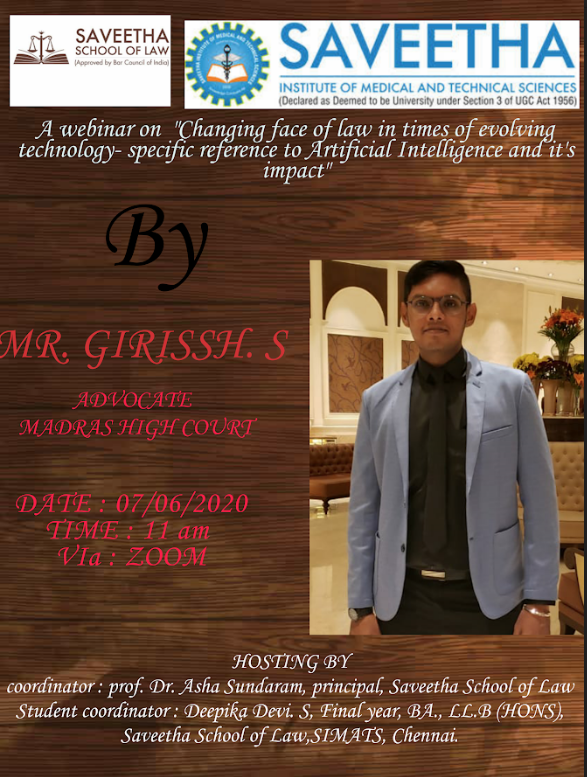
Changing face of law in times of evolving technology with specific reference to Artificial Intelligence

Mr. Girissh Sundaram the resource person of the webinar, provided an insight on what Artificial Intelligence (AI) is and explained about how far it is feasible to introduce AI in the field of law and the advantages of having such AI over human Intelligence. He had also provided several examples prevailing elsewhere in the world with regard to AI. The resource person also had raised several concerns about the capital expenditure for the purpose of introducing such software in the developing economy like India. He also gave insight on the input data and the output result when AI technology is to be incorporated in the legal field. He also addressed the concern of risk management regarding the data theft and other correlated cyber crimes. The resource person has concluded by raising the issue of reliability of the input data which is to be fed in and the risks that would be faced by the legal practitioners.

Read More
"Judicial Intervention for effective implementation of recent government reforms"

Mr. NIRMAL ADITHYA the resource person of the webinar, provided us with a various current issues and G.O.s passed and how judiciary intervened ,he also explained its use, how far it is effective and how various class of people get affected. Details of G.O and PIL filed for the same was also stated. Also he explained the tussle between judiciary and legislature on how each other override their jurisdiction to uphold their rules and guidelines. He explained various case laws in detail to understand the judiciary intervention in government reform and laid emphasis on standard retail pvt ltd v. M/S G.S. Global corporation & ors. He briefly explained the topics like moratorium period, FME(failure mode effect), termination of employees and reduction of wages. At last, the students asked the questions relating to moratorium period and its applicability. He also adviced the students to be updated with current affairs and law. At last he ended with the quote said by Bruce Lee that kungfoo is an art, u can learn it only when u have interest on it same way we have to love our profession in order to withstand it and succeed in it

Read More
Perjury and Indian laws

Advocate Arunagiri has spoken on the perjury and Indian laws in detail. In simple terms he refers to perjury as a false statement by witness or any incitement by advocate to make false statement by the witness, both advocate and witness are punishable under Section 193 of Indian penal code. Perjury means a witness giving a false statement in any stage of a judicial proceeding or fabricates false evidence for the purpose of being used in any stage of a judicial proceeding after taking the oath in the court of law. A witness who claimed he did not remember an event when questioned at one point in testimony, but who clearly recalled aspects of the event when asked later. This amounts to perjury based on the circumstance only. Any document produced to public officers written by the accused and later testifies a contradictory statement in court, it amounts to perjury.I conclude by saying that Amendment should be introduced in law so that the judge administering the oath should caution that he is bound to state truth on oath and if he does not state truth, he shall be prosecuted for giving false evidence so as to save the judicial system from being Deaf and blind.

Read More
WEBINAR- ‘ Forensic Science in Criminal Trials’

The Webinar on ‘ Forensic Science in Criminal Trials ‘ was organized by International Law Department, Saveetha School of Law, SIMATS,Chennai. Adv. Sasthamangalam Ajithkumar, CBI Standing Counsel, High Court of Kerala ,narrated about the relevance and importance of forensic evidences in proving unnatural and suspicious cases while other evidence become vague and irrelevant. He further explained about the relevance of criminal profiling, Autopsy/Post mortem Reports, forensic pathology, forensic toxicology, forensic anthropology and its use in criminal trials in reaching to a proper and final conclusion regarding the nature, cause and manner of crimes. Criminal profiling includes indepth analysis of the crime scene, analyzing the incidence and drawing comparisons with similar events and evaluation of victim’s past. He shared his experiences as a Defence / Prosecution Lawyer and explained how he dealt with forensic evidences in disproving and proving cases. The session was very informative and interesting.

Read More
Reclamation of PoK - Alliances, Road Ahead & Strategies.

Mr. Srinivas Jayaprakash provided a wonderful lecture on the topic Reclamation of PoK- Alliances, Road Ahead & Strategies. He began by addressing the problem of secularism in Kashmir and how it has changed over the years. Various opportunities that came our way that could have paved the way for India in becoming one of the most powerful nations in the world was dealt in detail and the reasons as to why we missed were also clearly explained.

The resource person precisely stated the need for well established strategies that would have long term effects for about 50-60 years rather than those that were prepared in the past with no foresight, which he states might be one of the reasons for us to be in the current position.

He rightly pointed out the history and economic reasons behind the reclamation of PoK and the aftermath of the merger. He also explained how India geographically located on a higher altitude gets the advantage of power over jurisdiction. The concept of military alliances were also briefed. International affairs between Pakistan, India and China were explained. The timeline of how Bangladesh would emerge as a powerful nation was also touched upon in the session.

On the whole it was a very insightful webinar and was attended by around 30 students from Saveetha School of Law.

Read More
CHALLENGES IN CYBER SECURITY AND LAW IN THE PRESENT SCENARIO

Prof. Dr. RANJIT OOMMEN ABRAHAM, Assistant Professor & Faculty Coordinator - MCA,, School of Excellence in Law, The Tamil Nadu Dr. Ambedkar Law Universtiy, "Perungudi Campus".

The webinar on 'Challenges in cyber security and law in the present scenario...' organised by Department of Business Law, Saveetha School of Law, SIMATS, Chennai. This webinar majorly focuses on Cyber Law in India, Need & Importance ,Need and importance of Cyber Law – Past, Present and future, Cyber Crime and Security– Meaning and Overview, Introduction of Cyber law, IT Act-2000, IT Act Amendment-2008, International developments , Cyber Law and Cyber security in Present Scenario, Need for the cyber laws Important aspects of cyber laws - Jurisdiction Issues Cyber Crimes, IPR Issues in Cyber Space, E Contracts, Digital Signature, E Banking, E taxation, E Governance, Categories of cyber crimes - Individual , Organization - a. Government, b. Firm, Company, Against the Individual Against Individuals Property , Cyber crime provisions under IT laws, IPC & other Specials Laws, IT amendments, Jurisdictional Issues, Recent treads, Privacy issues, investigations, Contractual Issues in Cyber space, Intellectual Properties issues in Cyber space, Infringements, Need for judicial transformations, Banking and financial Frauds, credit card skimmer, Phishing frauds, vishing, Sim Swap Frauds.

Read More
EVOLUTION OF CRYPTOCURRENCY AND ITS LEGALITY IN INDIA

Mr. K. Jeyamohan the resource person of the webinar had given a brief lecture on the concept of evolution of cryptocurrencies ,where he quoted Satoshi Nakamoto and his views on the underlying technical system upon which decentralised cryptocurrencies are based. He briefly touched upon the topic of Bitcoins, in particular and explained its value and how it has grown over the years.

He explained in detail about the legality of cryptocurrencies by clearly mentioning the powers conferred by both RBI and Central Government when it comes to legalisation of the same. He finally concluded on the possibilities of how this new technology has driven most of the current market capitalisation and how it would remain a case until a certain measure of price stability and market acceptance is achieved.

There were totally around 30 students that attended this webinar and he was patient enough to clarify all the doubts that were put up by them. It was an enriching experience on the whole.

Read More
Basic concepts of e-Insurance and types of Insurance- Life,Fire,Marine and Motor vehicles Insurance.

Mr.Meyyappan Kumaran the resource person enlightened us the topic "Basic concepts of Insurance and types of Insurance- Life,Fire,Marine and Motor vehicles insurance".He laid down the emphasis towards definition of Insurance in simple terms between the insurer and the insured persons followed by its kinds,with relevant seven principles and doctrines of contribution,subrogation ,Re-in statement so that it would be more enlightened to the students.He explained each and every principles of Insurance with relevant case laws, Harris V.S. Poland, Lucena vs crauford . Also he explained all the Laws governing to Insurance in India in a brief manner and then moved on with the types of Insurance in which he dealt with the whole life Insurance and endowment Insurance its dividend participation, the fire Insurance ,sections and its basic compliance with reference case laws addressing the students then moved on to the marine Insurance and motor vehicles Insurance in brief with appropriate case laws , with relevant doctrines and its types which is beneficial to the students.

At the end of the session ,Students also raised certain questions relating to the discharge scheme on insurance and also relating to the suicide clause,its malafide intention and the resource person answered to all the questions put forth by the student in an efficient manner ,on the whole it was very informative and Insightful session.

Read More
IMPACT OF RERA ACT,2016 IN INDIA

MR ANEES KHAN BALLB(HONS)CS.MBL gave a lecture on RERA act,2016 in India. A law graduate a great mooter and had took part in many conferences in UG. He started his career as a Legal Project associate at IIT Madras for Central Govt Law Drafting Projects. Later He worked as Regional Manger at Reliance General Insurance. At present he is the Manager- Legal Department at KLP Projects Private Limited which is an unit of Landmarks groups.He gave general introduction on The Real Estate (Regulation and Development) Act, 2016. Some quick important points of RERA which makes it mandatory for all builders – developing a project where the land exceeds 500 square metre -to register with RERA before launching or even advertising their project. Developers will have to submit as well as upload project details, including approved layout plan, timeline, cost, and the sale agreement, that prospective buyers will have to sign to the proposed regulator. It also states that any structural or workmanship defects brought to the notice of a promoter within a period of five years from the date of handing over possession must be rectified by the promoter, without any further charge, within 30 days, he added.The State RERA office has four wings: Finance, Legal, technical and administration and IT.He also gave gist on Registration of apartments.Before applying for registration, the layout of the real estate project has to be approved by the local authority like BMC.All commercial and residential real estate projects will have to be registered except where Imprisonment of up to three years for developers and up to one year in case of agents and buyers for violation of orders of Appellate Tribunals and Regulatory Authorities. He also explained about penality under RERA,ACT 2016.

Read More
GENDER BASED VIOLENCE AND EXPLOITATION THROUGH CYBER STALKING

The speaker for the webinar was Shri.R.Sandhya who serves as a EC Council Instructor at TIFAC CORE, Coimbatore . The session was attended by about 30 students . student coordinator, Rukmani started off the session by giving an introduction of the speaker. session started with an overview of CYBER CRIME AND INFORMATION TECHNOLOGY ACT. The speaker discussed the provisions of the Act and the session was made interesting with live examples and the practical aspects. The speaker highlighted the legislation involving the right to privacy and explained about the various types of offences mentioned under the act like Cyber Terrorism, Cyber Stalking, Identify Theft and so on. The punishment prescribed under the Act, conflicts in the provisions of IPC, CRPC. The session was concluded by SUSURUDHAN with a Thankyou note.

Read More
Ancient International Law

Modern international law is the outcome of the Judea- Christian Tradition of the European nations. The Non-Western perspective has challenged it for quite a long time by various streams such as Third world approach to international law, Asian approach to international law, Non-western approach to international law etc. The arguments of these approaches counter the western strategy by saying that the beginning of international law is not from the Treaty of Westphalia, but much earlier. It was not only practised in Europe but also practised in various geographical areas of the world for an extended period. One such practice this article highlights is from the Sangam period of the ancient Tamil land. The Sangam period is according to the recent excavations in Keeladi dates back to 600 BCE. It was the period that the formation of state happened in south India. We can see many poems which give the rules of war in the ancient Tamil land. Sangam literature and classic Tamil text Thirukural, which dates back to 2000 years, has the sources of early Tamil international law. In Asia, states existed from ancient times with sovereignty. There were wars frequently among countries. Diplomacy was used in many instances to avoid conflict. In the Oriental philosophy, the king was the absolute sovereign but the least he acts without the advice of the council of ministers or intellectuals. The advisors were mostly the intellectuals and also a poet. One such incident before 2000 years was by a woman who avoided a war between two states by the means of diplomacy. King of Kancheepuram, Thondaiman, declared war against the King of Thagadur, Adhiyaman. Adhiyaman sent his friend and advisor, Avvaiyar, a woman poet as a diplomat to avoid the conflict. She helped in preventing the conflict through her negotiating and artistic skills. This is clear evidence of diplomacy in ancient times. In the post-Sangam period, this has evolved into full-fledged international rule on diplomacy. Thiruvalluvar, in his Thirukural, had written poems about diplomacy. While speaking about the qualities of a diplomat, he says that they should be scholarly among scholars, have extraordinary communication skills with loving nature, appealing personality, pleasing manner, benevolent heart, humorous in the talk, courageous by nature, etc. According to him, a top-level diplomat is a person who understands very well the responsibilities of his duties, wait for the right time to speak and determine the correct place to perform his diplomatic mission by using measured and well-tempered words. A diplomat faces threats often in the enemy country. He further says that even when there is a threat to his life, an ideal ambassador will serve his country without any fear. This was not only noted in the literature, but practiced during that age. To this end, this webinar will discuss the manifold contributions of the Tamil world to the development of diplomatic tools in international peace and security.

Read More
Religious Rights under the Indian Constitution

Webinar on Religious Rights under the Indian Constitution . The Event was coordinated by Prof.Dr.Asha Sundaram, principal Saveetha School of Law, and Leelesh Sundaram.B with 50 participants across the country. The speaker of the session was Adv. Prashant Padmanabhan advocate on record, Supreme Court of India.

The lecture commenced with an explanation on various religious rights available to the Citizens, the role of customs and religious practices. the speaker also explained different types of religious secularism and ground norm. The lecture also covered the Constitutional framework for religious rights. After the lecture, for the next 20 minutes the participants got their doubts clarified. The webinar served a great purpose as it enabled students to understand the role and scantum behind religious rights in India

Read More
OVERVIEW ON ENVIRONMENTAL LAWS

The webinar resource person was Mr. T. Sai Krishnan, Advocate, Madras High Court with an experience of more than 25 years. The student coordinator introduced the guest by giving an introduction about the speaker. The speaker started his lecture on the laws followed in India for the protection of our environment. He covered all the legislation that govern environment such as Water Laws, Air Laws, Rules, etc. The speaker also explained about the National Green Tribunal and its functions. He also briefly explained about the working of the NGT. The speaker concluded the session by summarising the key points. The student coordinator concluded the meeting by thanking the speaker and the students.The session was attended by about 50 students.

Read More