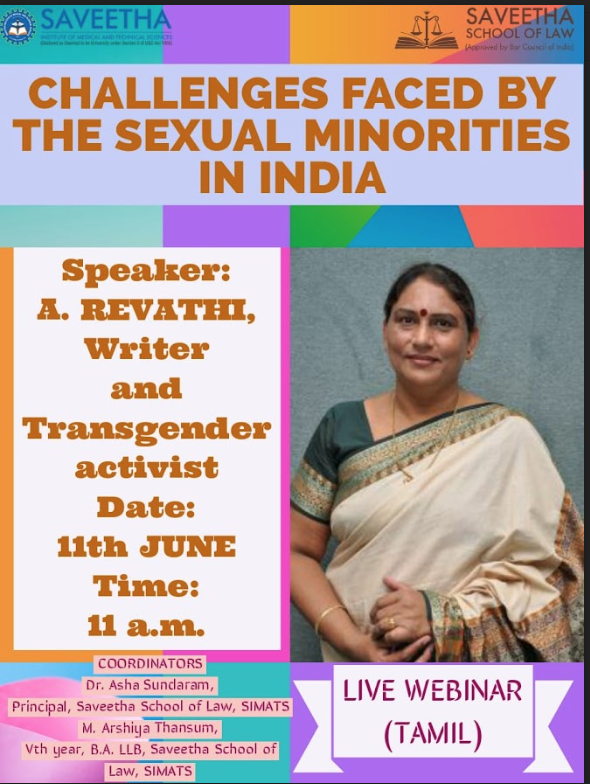
Challenges faced by the Sexual Minorities in India

The webinar had begun with a small introduction of the speaker by M. Arshiya Thansum. The speaker then went on to speak about her personal experiences as a transwoman. She had given us some excerpts from her autobiography as well. She briefed us about the origin and evolution of the LGBT Community especially the Trans Community. She also emphasized the need for reservation and inclusivity of the Trans community in mainstream society. She gave us an insight as to how difficult it is to live as an outcast in the society. She also brought attention to the recent Trans Bill passed stating how regressive it is for the Community. She concluded saying that it is both law and the society that has to work together to bring about a change in the community. Then we moved on to the Question session. There were a lot of questions put forward by the participants to which the speaker had patiently answered. To sum up the webinar was a success and both the speaker and the participants had a valuable time.

Read More
LEGAL AND PROCEDURAL ISSUES IN INITIATION AND CONDUCT OF INTERNATIONAL COMMERCIAL ARBITRATION

The webinar was presented by the Speaker M. SRINIVASAN Founder, CENTRE FOR LEGAL EDUCATION & APPLIED RESEARCH (Regd.) on the topic "LEGAL AND PROCEDURAL ISSUES IN INITIATION AND CONDUCT OF INTERNATIONAL COMMERCIAL ARBITRATION" on June 11, 2020 around 10.00 AM. The session starts with the aspects of legal and procedural in initiating and conducting the International Commercial Arbitration. It started with the basics that included that Section 2(1)(f) of The Arbitration and Conciliation Act, 1996, defines an International Commercial Arbitration. The scope of this section was determined by the Supreme Court in the case of TDM Infrastructure Pvt. Ltd. v. UE Development India Pvt. Ltd , where in spite of the company having a foreign control, the Supreme Court concluded that, “a company incorporated in India can only have Indian nationality for the purpose of the Act.” Further it involves answering questions such as When Arbitration is Deemed to be International and Why Arbitration preferred in solving International Disputes. It came to know that the International commercial arbitration is used as a Speedy dispute solving mechanism, It is more readily and swiftly enforced as compared to the court judgements and Arbitrator chosen may be an expert in solving International Problems. The session concludes with the recent significant increase in international businesses operating out of India. This has led to an increase in international arbitrations having its seat of arbitration in India.

Read More
Importance of social service in personal growth of children

The webinar started at 6.00PM on 10th July 2020. The student organiser gave a brief welcome note and introduction of the resource person. The resource person started her lecture by welcoming all. She explained about what kind of social work she does in the organization and the purpose of her organization. Later she explained the role of motivation in a child's mental health alongside she explained about human connection that must be maintained with the children in the growth of children. Later she talked about how, education system can be better if it is customized according to each student. Moving from the education she talked about empathy and how it plays major role in social service. She quoted many legendary people words including Nelson Mandela and Mother Teresa. Before winding up she did a little activity regarding learning pattern.

Read More
Trademark Registration Process and Trademark Infringement

The Webinar started successfully at 5 PM. Around 16 students had joined. The webinar started off with a small introduction of the speaker by M. Arshiya Thansum. The speaker had shared his PPT with the participants for all of us to follow. The speaker had started the webinar defining what INTELLECTUAL PROPERTY RIGHTS meant and briefed about its types. He later went on to elaborate about the Origin of Trademarks, it's history, it's types and definitions and gave us examples of some popular trademarks. After this he had emphasized about the technicalities involved in Trademark Registration. He had also stated in detail about Trademarks Infringement citing some prime case laws about the topic. Once this session got over the question session had started. All the participants had come forward with their curious and valuable questions. They were interested in knowing about a career in IPR law, how to protect one's trademark, how to apply for a trademark, etc. The speaker had patiently answered all our questions. To sum up the webinar was a success and both the speaker and the participants had a valuable time.

Read More
MEDIA DEMOCRACY IN DIGITAL COMMUNICATION

MEDIA DEMOCRACY IN DIGITAL COMMUNICATION Session Was Hosted by Miss MJF LN Sri Durga Priya, with a Number of 15 Student participant Miss MJF LN Sri Durga Priya Presented welcome address of the presenter”Miss A. HIMANA “..Researcher on Academy of Sciences in Czech Republic.Completed her Phd on Disaster Management From University of Madras.Masters Degree in Geography from University of Madras.Bachelors Degree in Geography from University of Madras session Headed by Miss A. HIMANA for the students with Contribution of GIS technology in policy making and law enforcement.

Miss MJF LN Sri Durga Priya presented the vote of thanks.

Read More
A WEBINAR ON PROSPECT OF LEGAL SECTOR AS CAREER FOR LADY LAWYERS

The Resource Person was Advocate Shubhangi, Drafting Associate in Nathan & Associates, Chennai. She was the speaker of the session.

The Speaker, Advocate Shubhangi Started the session, giving a self introduction about her. She shared her experience as a Lady Lawyer and gave many advice and tips to the audience on how to succeed in the law field as women in this society. Later she talked about the importance of drafting which plays a major role in Law and is an important advocacy skill. Women in the Legal sector play a predominant role. The Legal Sector is one of the important sectors which does not distinguish between Male and Female. The Speaker stated that in case of difficulties as a lawyer we have various choices like to join in a drafting committee, legal adviser or consultant, Professors, corporate side, and we also have various opportunities to attend competitive exams like UPSC, TNPSC, JAG, etc., to become a Civil Judge or District Judge, IAS, IPS Officers, Public Prosecutor. The Speaker concluded the session by stating that women have equal opportunity as Men. women have more opportunity in the legal sector as a Career for Lady Lawyers.

Read More
Media Ethics

The resource person Mr.V.Ganesh was welcomed and introduced by the student coordinator and his topic of interest for today's webinar was on Media ethics .There are basic principles which the media should follow in any of their shows. The 5 basic principles for media ethics where clearly explained by the resource person . But most of the media in recent times being corrupted, telecasts some fake or hidden news. The content given by the media should take care of what to be telecasted. Laws and Rules are still active and the media takes up the responsibility whether to follow or to develop their commercial activities. Overall the webinar was productive to the participants where they came to the rules and law binding media.Students also to part in questionnaire session and the webinar was concluded by vote of thanks by the student co coordinator.

Read More
USE OF INFORMATION TECHNOLOGY FOR LAWYERS

Mr.Vasudevan Radhakrishnan is the Resource person for this Webinar. He spoke about the use of Computers and Accessories for budding lawyers. He also laid emphasis on various IT enabled transformations namely Social, Mobile, Automation and Cloud which would enable lawyers to make best use of it. He explained how the IT enabled Legal System would function. He also dealt in various Business features like Client Management, case management, Documents and repository management as well as Legal Firm Management. He also quoted day to day examples on how a legal IT firm works and how lawyers could make best use of IT in the present scenario. He made the students acquainted with basic knowledge on Information Technology which will help them in future. Students gave feedback which was also welcoming.

Read More
Contribution of GIS technology in policy making and law enforcement

Contribution of GIS technology in policy making and law enforcement Session Was Hosted by Miss MJF LN Sri Durga Priya .With a Number of 23 Student participant Miss MJF LN Sri Durga Priya Presented welcome address of the presenter” MrA.Mahesh..RResearch Assistant with ICMR (Indian Council of Medical Research).Research Scholar in Department of Geography at University of Madras.Masters in Technology in GeoInformatics.Masters Degree in Applied Geography from University of Madras.Bachelor's Degree in Geography from Madras Christian College.Session Headed by Mahesh A for the students with about Contribution of GIS technology in policy making and law enforcement. Question and discussion session went on for Students Clarifications and doubts.

Read More
DRT ACT & SARFAESI ACT

Introduction by Mr.K.Rajasekaran and he was dealing about the topic. DRT Act and SARFAESI Act.He explained the Debt Recovery laws .Government has appointed for the foreign investors Shri M Narasimhan and Shri T Tiwari Committees .He further explained how the Recovery of debts happen due to banks and financial institutions .

Borrower deals with the section 2(1)(f) of the SARFAESI Act. Important provision of SARFAESI Act .

Section 13-Enforcement of security Interest

13(1)-security interest

13(2)-Demand notice

13(4)-Possession notice

Section 14-Chief metropolitan magistrate or district magistrate to assist secured creditor in taking possession of secured assets

Section 17 -Application against measures to recover secured debts

Section 19-Application to the tribunal

Section 20-Appeal to the Appellate Tribunal

Section 34-No civil court shall have jurisdiction

Case laws

Swiss Ribbons vs union of India (2019) 4 SCC 17

Mardia Chemicals ltd vs Union of India (2004) 4 SCC 311

Transcore vs Union of India(2008) 1 SCC 125

The session was concluded with questionnaire and overall it was effective webinar .

Read More
LAW OF ARBITRATION

The speaker for the webinar was Mr. T. C. Gopalakrishnan, Advocate, Madras High Court who has an experience of more than 10 years. The session was attended by about 20 students. The student coordinator started off the session by giving an introduction to the speaker. The speaker started his lecture on the Introduction of Arbitration. He discussed almost all the principles and philosophies of Arbitration. The speaker also explained about all the Tribunals and its functions. He briefly explained everything with case laws and their citations. The speaker concluded the session by summarising the key points. The student coordinator concluded the meeting by thanking the speaker and the students.

Read More
LAW AND LIFE

Advocate Adhilakshmi Logamurthy spoke on law and life. She started her discussion with basic rules of life. How the law plays its role in the life of us and how we should carry forward it in our life as a budding lawyer and as an advocate. Law and life are interdependent to each other and they never separate. As a lawyer we have to know 7 mantras in life. Time management is the first mantra which is important in life and legal career. Second mantra is accept the false and mistakes.In legal profession everyone has to accept the mistake and they have given an opportunity to amend the mistakes. Communication involves not only speakingbut also includes drafting and evidence. Reputation is the fourth which is essential in life. Reputation is not only for life or for profession it takes a person to a great phase in his life. She quoted a book of Gandhiji "A brief Insights" for how a lawyer should have a reputation. Reading and learning enhances the knowledge of a person. Reading keeps the person to grow higher in their life.Last mantra is accept the criticism given by others. Criticism means always negative but it is a positive way in which it changes the life of a person. At Last, she concludes saying as a lawyer we have to understand that while expecting one thing , unexpected things may happen. So law and life are dependent on each other.

Read More
LOCKED DOWN IN POVERTY MIGRANT DOMESTIC WORKERS IN LEGAL PARADIGM

This webinar began with a welcome address by Dr Betsy Rajasingh and a brief introduction about the speaker by student coordinator Mr. Sandesh Saravanan. Dr. Sophy then commenced her lecture recounting the plight of domestic workers in India. She highlighted the double discrimination faced by domestic workers – chiefly women – and the complete political apathy and legislative lethargy that surrounds their work and their lives. Falling under the unorganized sector, she highlighted how about 45 million domestic workers in India, both from the live-in and live-out category faced denial of rights as there was no sui-generis legal framework that guaranteed their rights. She then went on to point out with specific case-study, how most of the migrant domestic workers faced insurmountable hardships on account of the lock down announced by the Government. The lecture was a comprehensive account of the conditions of domestic workers in India, which the students found so interesting, that a large chunk of time after the lecture was devoted to a very lively Question and Answer session.

The Webinar was co-ordinated by Dr. Asha Sundaram, Principal Saveetha School of Law, Dr. Betsy Rajasingh, Assistant Proffesor, Saveetha School of Law and student co-ordinator Mr. Sandesh Saravanan. About 40 students engaged themselves in the Webinar, which concluded with a vote of thanks by Mr.Prem Ranganath.

Read More
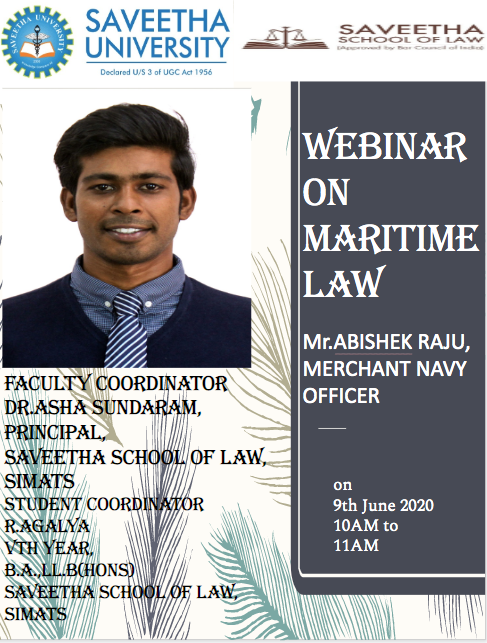
Maritime Law

The webinar started at 10.00AM on 9th June of 2020. The student organizer welcomed the special guest and the participants. The guest started his lecture from the important codes and convention of IMO(international maritime organisation). He lectured about the safety of life at sea, the causes of marine pollution and how they could be reduced and prevented in various situations, specifically about the pollutants which are caused by oil, noxious liquid, harmful substance in packed form, sewage, garbage and air(MARPOL ANNEXES). Moreover he explained about the special areas, special emission controlled areas and the important certificate to be carried onboard ships. By the end he answered the students doubt about the International Maritime Organisation . By 11.10 AM the webinar ended.

Read More
Plight of Migrant Labourers amidst COVID Pandemic - Legal issues and challenges

Mr. Sachin Menon, Asst. Professor in Co-operative School of Law, Kerala, was the guest lecturer for this webinar. The webinar was attended by almost 47 people. The session was started off by a welcome address by Mahima Makhija, followed by which Sachin Sir expressed his gratitude towards our College for giving him this opportunity. He started off his lecture by addressing the difficulties faced by the migrant labourers. He stated that “this pandemic is a human tragedy of the greatest extent”. He also categorised the migrants into different levels and called them to be a part of the vulnerable group of our society. Further, he spoke about the steps taken by the Apex Court for the migrant labourers, such as the Shramik trains facility throughout the whole of India as an attempt to relocate these migrants from their workplace to their hometown. He then spoke about the failure of the measures taken by the State Government of Delhi in relocating these labourers as he said that this failure should be treated as a legal issue. He further stressed upon the need of having a proper mechanism for such migrants and that the government is required to be accountable and transparent. He also said that the Indian Constitution is the Supreme Law of our country and there is no law beyond that. He then concluded his talk with a positive note by stating the order that was passed today in relation to the relocation of the migrant labourers in our country. The participants then enthusiastically asked questions and Mr. Sachin appreciated one question that is, with regard to the possibility of enforcing a task force for these migrant labourers. Overall, the session was very informative and interactive.

Read More
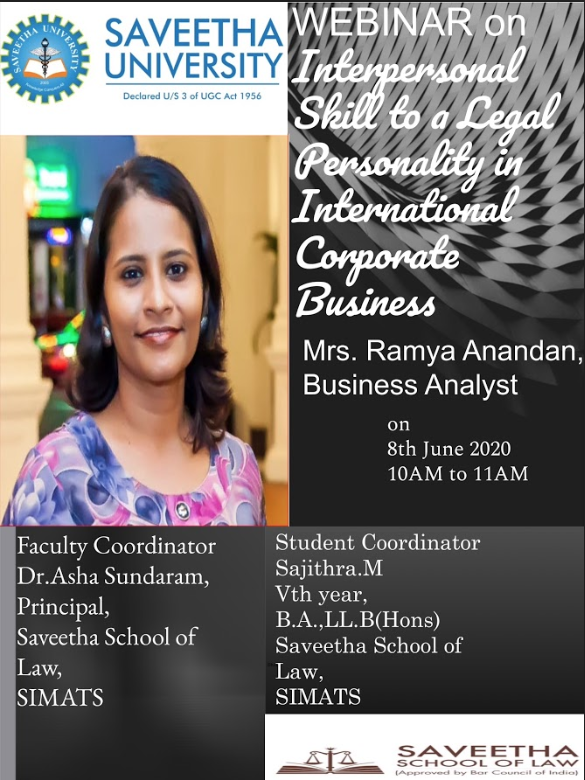
Interpersonal skill to a legal personality in International Business by Mrs.Ramya Anandan

The webinar started at 10 Am on 8th June of 2020. The student organizer welcomed the special guest and the participants. The guest started her lecture from the Interpersonal skill definition and its kinds. Then she moved on to the concept of Verbal Communication, Non verbal Communication and Relationship Management. In verbal communication she explained what to say, construction of words and importance of power of small talk. In non verbal communication she explained about body language and how to make strong connections. In relationship management she stated the importance of knowledge building. She Also explained about the need for lawyers in a Business, in which she explained about the understanding of Business, legal advice and need of fluency in expression and language with a PPT presentation. By the end few students raised questions during the time given for asking questions to the resource person, she has cleared all the doubts to the students 11.10AM the webinar ended.

Read More
AN OVERVIEW ON DISASTER MANAGEMENT ACT, 2005

  • Resource person started the seminar by thanking the Institution for this opportunity.

  • The resource person started by mentioning about the "Declaration by the UN" un 1990's on International Decade for Natural Disaster Reduction (IDNDR).

  • Mentioned about entry 23 of the Union list regarding enactment of NDM Act.

  • Mentioned about the object of the Act and also important definitions.

  • Explained about the powers and functions of the National, State, District and local authorities.

  • She explained each authorities function by comparing it with the real time (i.e., COVID-19, Chennai Flood and other Disasters in India)

  • Finally she spoke about the criticism and drawbacks in implementation of the Act.

The participants raised certain questions regarding the present COVID situations and it's failure and also about the other drawbacks in the Act.

Read More
WEBINAR ON - THE LOCKDOWN & THE PLIGHT OF MIGRANT WORKMEN - A LEGAL PERSPECTIVE WEBINAR ON - THE LOCKDOWN & THE PLIGHT OF MIGRANT WORKMEN - A LEGAL PERSPECTIVE

The resource person Advocate. R.Pandian in his brief session introduced the concept of Migrant Workmen from the colonial history, the formulation of the Contract Labour Act till the formation of the Migrant Workmen Act. The session focused its importance to the plight of migrant workmen during this COVID19 Lockdown and probable solutions to the same. It was a jam packed session which served as a capsule to understand the current concept. The participants were provided with the opportunity to put forth questions to the resource person. The resource person was patient enough to solve the doubts raised and encouraged inquisition. The organiser conclusively gave a closing note thanking the resource person for donating his time and the management & Principal for providing with this opportunity. It was an enlightening session on a much needed area of law.

Read More
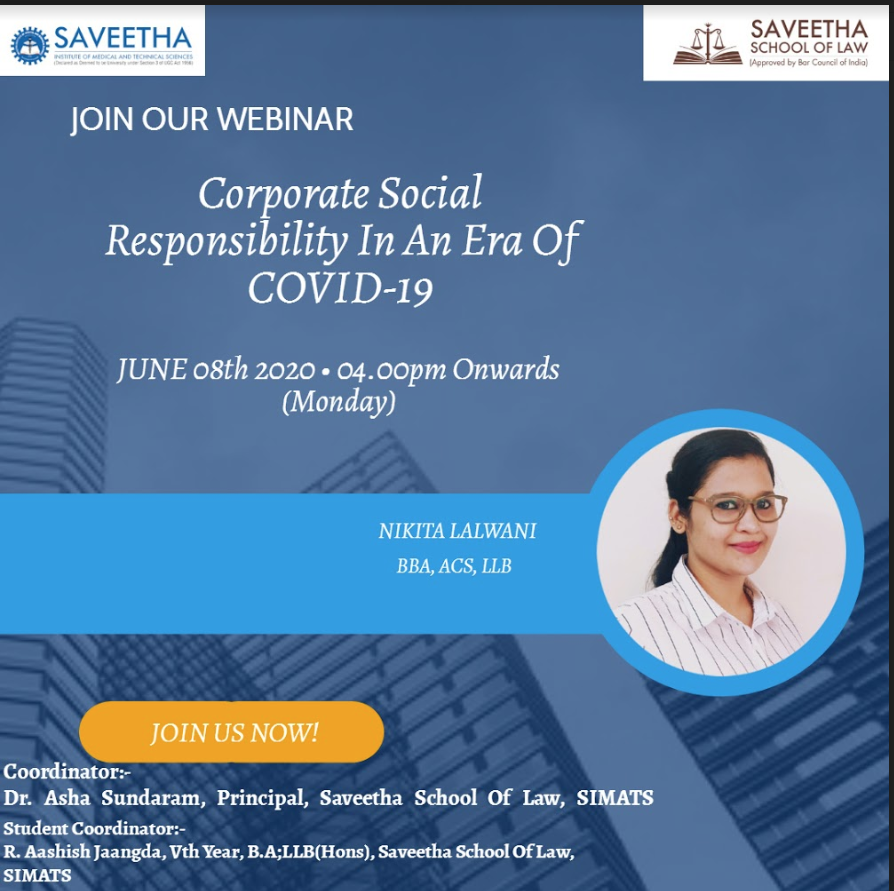
An Corporate Social Responsibility In An Era Of COVID-19

In the webinar, speaker taught us the definition of the CSR and the role played by them in the protection of the environment and the various schemes implemented by them for the benefit of the Schedule caste ,the schedule tribe or the backward class people by providing education , facilities which they are lacking in their areas or the development of the rural area. The corporate social responsibility sometimes goes beyond the efforts taken by the regulators of it. Many examples were given by the speaker to make the participants understand the importance of the CSR and also when the companies are eligible for claiming the corporate social responsibility from the government was explained. Under the section of the companies act 2013 the corporate social responsibility is being explained and the exceptions.

  • Eradicating hunger, poverty and malnutrition, promoting health care including preventive health care and sanitation  contributing to the Swachh Bharat Kosh set-up by the Central Government for the promotion of sanitation and making available safe drinking water.

  • Promoting education, including special education and employment enhancing vocational skills especially among children, women, elderly and the differently abled and livelihood enhancement projects.

  • Promoting gender equality, empowering women, setting up homes and hostels for women and orphans; setting up old age homes, day care centres and such other facilities for senior citizens and measures for reducing inequalities faced by socially and economically backward groups.

This was the period where the Covid-19 came into play

  • 23.03.2020 : Funds may be spent for various activities related to COVID-19 under item no. (i) to (xii) of Schedule VII relating to promoting health care, including preventive health care and sanitation and disaster management (including State Disaster management Fund).

  • 28.03.2020: Contribution to PM cares fund shall qualify as CSR expenditure under item (viii) of schedule VII

Salary of Employees during lock-down and payment to casual / contractual workers NOT CSR. Any ex-gratia payment is made to temporary / casual workers / daily wage workers over and above the disbursement of wages, specifically for the purpose of fighting COVID-19 , the same shall be admissible towards CSR expenditure as a one time exception provided there is an explicit declaration to that effect by the Board of the Company, which is duly certified by the Statutory Auditor.

And then few examples about the MNCs and the Indian based company the strategy they are using to make awareness about the social distancing .

Read More
A WEBINAR ON MOOT COURT AND MOCK TRIAL

Guest : Deeraj Thiyagu talked about how to read the facts thoroughly and  frame the issues according to the question of law and question of fact and how to apply the mind and to look upon citations as well prepare the arguments 

The Five rules are

  • To have a good team.

  • Court manners

  • To know the basics

  • To understand the question of law

  • Be thorough with the facts of the case.

He also told us about how to prepare the memorial:

  • Always go by the rule given by the institution.

  • Follow the IRAC rule - Issues, Rule of law, Analysis/Arguments and Conclusion.

  • Do not copy paste from the website.

  • Always be precise.

  • Do not insert lots of cases.

He asked to avoid these Common mistakes:

  • Compromising your team.

  • Entire team must prepare. All should put in equal amount of work.

  • Ignorance of law.

  • Not being thorough with the facts.

  • Not having court manners.

Always refer several case laws, books, websites as well journals. As Mooting is an important part of a lawyer's education, should participate and gain experience.

Read More